
China has set an ambitious target to achieve carbon neutrality by 2060, and promised the economy-wide net greenhouse gas (GHG) emissions reduction in its 2035 Enhanced National Determined Contribution (NDC). However, transitioning from carbon dioxide (CO₂) neutrality to comprehensive GHG neutrality demands significantly more cross-sectoral mitigation efforts. A new multi-model integrated framework has revealed that while CO₂ emissions are expected to peak before 2030, energy-related CO₂ emissions must be reduced to zero by 2060, while non-CO₂ emissions must decrease by 60%. This shift requires the expansion of carbon capture technologies, including direct air carbon capture and storage (DACCS), and substantial improvements in energy efficiency and renewable energy adoption.
A study by Tsinghua University, published (DOI: 10.1016/j.ese.2026.100695) in Environmental Science and Ecotechnology in 2026, titled Toward Greenhouse Gas Neutrality: China’s post-2030 Transition Pathway and Policy, explores China's transition from CO₂ neutrality to full GHG neutrality by 2060. The study indicates that achieving GHG neutrality by 2060 will demand substantial additional efforts compared to CO₂ neutrality. In the GHG neutrality scenario, energy-related CO₂ emissions must be reduced by 100%, with energy systems becoming predominantly electric, powered by renewable sources like wind, solar, and hydrogen. By 2050, the energy system must see a significant shift, with non-fossil fuels contributing 85% of the energy mix. The power sector will be the last to peak, reaching carbon neutrality by 2055, while industry and transport will need to drastically cut emissions, especially with the help of carbon capture technologies. The study also highlights the importance of non-CO₂ emissions reduction, particularly in agriculture and industrial processes, with reductions required to meet the 60% reduction target by 2060.
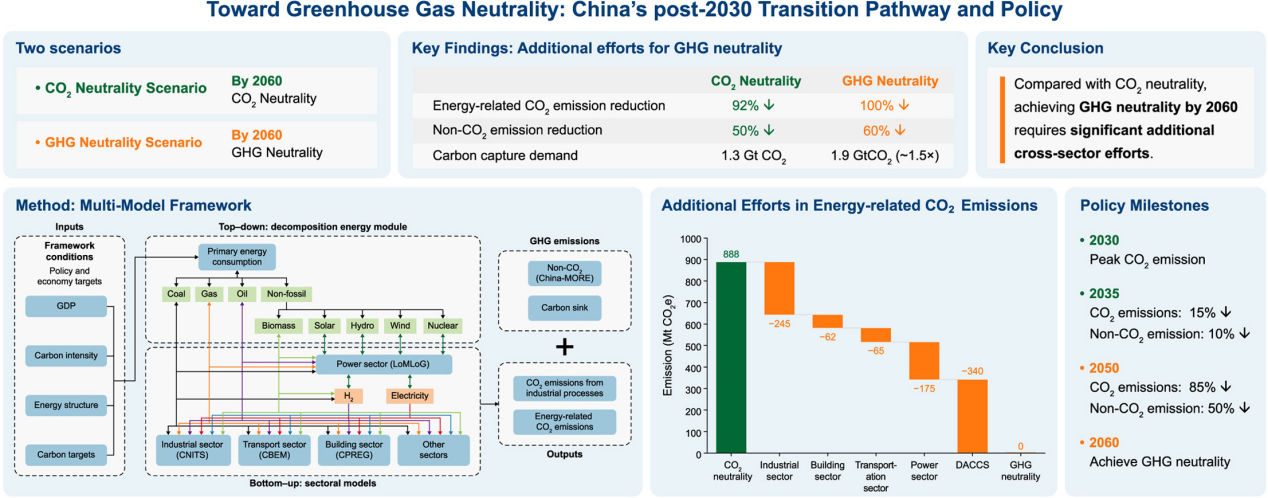
China's path to GHG neutrality by 2060: key milestones and sectoral efforts.
China's path to GHG neutrality by 2060: key milestones and sectoral efforts. This infographic illustrates China's transition toward GHG neutrality by 2060, comparing the efforts needed for CO₂ and GHG neutrality scenarios. The chart highlights sectoral emission reductions and the additional carbon capture demands required, emphasizing the significant efforts necessary across industrial, building, transportation, and power sectors. Key policy milestones include achieving peak CO₂ emissions by 2030, reducing emissions by 15% by 2035, and targeting 85% CO₂ reduction by 2050.
China’s climate policy has long focused on achieving carbon dioxide peaking before 2030. However, the need to comprehensively address greenhouse gas emissions, including both CO₂ and non-CO₂ emissions, has become clear. The GHG neutrality target requires more aggressive emissions reductions across sectors such as industry, energy, buildings, and transport. The need for a 2035-focused medium-term climate strategy toward GHG neutrality is essential for connecting current policies with long-term targets, and aligning China’s domestic strategies with global climate objectives.
“This study reveals that the path to GHG neutrality requires unprecedented cross-sector efforts, extending far beyond CO₂ reduction,” said Dr. Ershun Du, a lead researcher from Tsinghua University. “The integration of innovative technologies like DACCS and the large-scale electrification of end-use sectors are critical to reaching these ambitious goals. By acting swiftly, we can steer the country toward a sustainable and resilient future, aligning with both national and global climate targets.”
The findings from this study have critical implications for China’s long-term climate strategy and policy frameworks, as well as for the Global South’s mitigation ambitions and actions. The emphasis on reducing non-CO₂ emissions highlights the importance of a holistic approach that includes both mitigation and adaptation strategies. Furthermore, the research underscores the need for international collaboration and the scaling up of technologies for carbon capture, green hydrogen, and hard-to-abate sectors. As China accelerates its decarbonization efforts, the lessons learned from this study can inform similar pathways for other nations seeking net-zero emissions. China’s role in global climate governance as a leader and trusted partner will be pivotal in shaping the future of climate action.
- end -

Students from the Department of Energy and Power Engineering, Tsinghua University Visit Imperial College London, the London School of Economics and Political Science, Oxford and Cambridge

LSE and Tsinghua University award twelve joint projects advancing global sustainability

Marching towards COP30 – GAUC Action Plan for Belem